
History:
The Jade m.b.H has built the ship on the Rolandswerft Bremen in 1963 after
a design from Knud E. Hansen,
 Kopenhagen.
This ship is most probably the most beautiful of the Helgoland cruises. The ship
is still in service today and is takes travelers for day trips from Wilhelmshaven to Helgoland, the German Island
in the Northsea. The trip takes three hours. The ship belongs now to the Reederei
Wilhelmshaven Helgoland Line. Trips can be booked with company
Warrings,
Wilhelmshaven
http://www.reederei-warrings.de . The ship has places for 1100 passengers.
Kopenhagen.
This ship is most probably the most beautiful of the Helgoland cruises. The ship
is still in service today and is takes travelers for day trips from Wilhelmshaven to Helgoland, the German Island
in the Northsea. The trip takes three hours. The ship belongs now to the Reederei
Wilhelmshaven Helgoland Line. Trips can be booked with company
Warrings,
Wilhelmshaven
http://www.reederei-warrings.de . The ship has places for 1100 passengers.
Photo with permission of : Reederei Warrings, Wilhelmshaven
The Model:

The model was first published in June 1963, which means the model was published at the same time, when the original ship was first taken into service. The original release was published in two different sizes and it is most likely that the smaller format was intended as advertising for the shipping company. As you can see on the cover (first picture) still the Jade Verlag who took over the company in 1967 from the original company the "Lehrmittelinstitute" printed this model. In 1988 Jade Verlag was taken over by the Moewe Verlag, the present company who owns Wilhelmshavener Modellbaubogen now. The model is a water line model and not very complicated. It could have more details but the particular design of this ship, makes it still a nice model. The printing quality and fit of the model is very good.
The Kit:

The Scale of the model is 1: 250. The kit consists of 2 pages 430 x 300 mm. The model has 321 parts. The instructions are written in German only. The ship is not difficult to build and if you have some experience with ship models can you can built it without understanding the German instructions. The kits are now only available as laser reprint for the 50 Anniversary of the Wilhelmshavener Modellbaubogen, although I have built the model from an original print, which is not available anymore.
Construction
When I started this model I had in mind again to further experiment on methods on improving the stability of the hull and decks. This model was very suitable for it as it was small and easy to built. Nevertheless if you want to built this model, the strengthening of the decks and frames is really not necessary. The size of the model makes it stable enough for you to use as is. Until now I had used the method of shortening the frame by thickness of cardstock added to the deck, which in my case is 0.8 mm. This has its challenges and I decided to try another method. This time I scanned the deck parts and printed them. This duplicate deck was laminated on a 0.8 mm cardstock. Then I took the spine, marked, position it on the underside of the deck duplicate, and marked the position of the spine and bulkheads/former. This way I created a mirror of the spine and bulkheads. I cut the deck parts along the marked line into the individual segments and glued them to bulkhead structure as seen below. This proved to be not easy as the predicted, as the bulkheads/formers are not exactly ending up, where you expect them to be. So I had to make a lot of adjustments. Overall this method proved not be an advantage over the previous method I used. It seems every method has a catch. I will keep trying.


The original deck pieces in the original thickness were glued on this structure after finishing the complete hull. But before I glue the deck on I prepare the hull sides. I always cut out the windows and attach a window foil, which I prepare myself. If one window ends up in the position of a gluing flap of the bulkhead former, you will see the white and this looks ugly. I remove the flaps at the overlapping positions. The picture below shows the same technique used on one of the walls as an example.

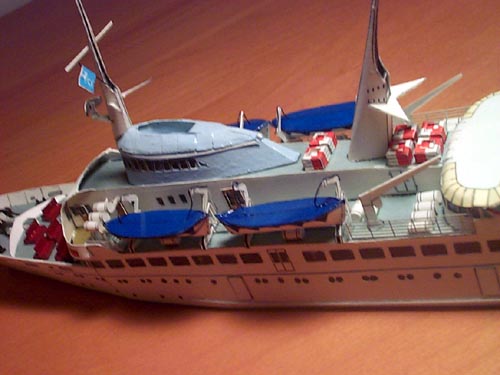
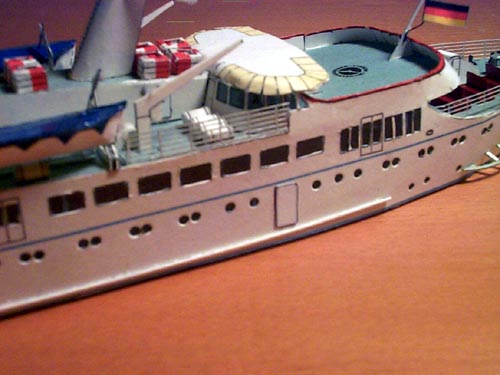
After finishing the main superstructure I came across a typical problem of cardmodeling. It is not possible to bend a part conical three dimensional in two different directions. The example is the picture left, where you see the top of the front forehousing. If you look closer, you will see that the designer tried to resolve this by cutting the top parts into segments. The result looks unfortunately unrealistic and the surface is kind of bulgy. I decide therefore to form the part smooth by applying some wood glue and painting it matt white. The results you can see in the next picture.

ou can still see the segmenting on top of the window, but keep in mind that the light reflection of the photo shot amplifies the structure of the surface. In real life it is hardly noticeable, which is an improvement.
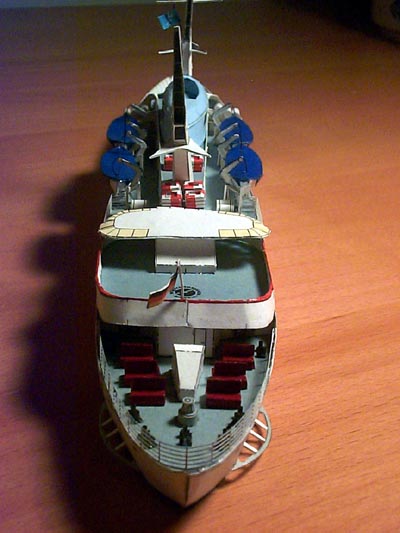
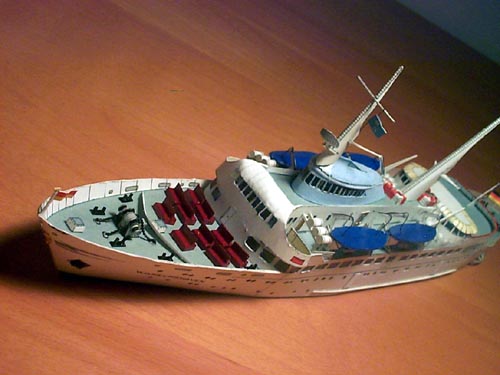
 I also used the same technique for the funnel, which is obviously not a real one. For me this is the most interesting design feature of this ship that gives it the very particular look. You can still see some of the segments on the top. Most of them have been smoothed out and I painted the funnel later with a gloss color, which might have been a mistake, a flat would have been better. I also realized later on the picture of the real ship that the color is a dark blue. I do not know whether this is a design mistake or if the color was changed later on the ship. I also painted the benches in a red tone with Humbrol colors, as I did not like the paper look to much. I did replace the anchor chains out of paper with an anchor chain from Weinert, which are distributed by Moduni (HMW).
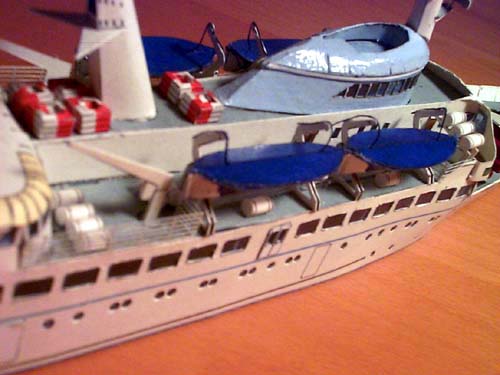
I also changed the life saving boats, which have a blue cover. In original design the boat has a top cover printed on the hull and it therefore does not appears as to be a cover but just a decoration of the hull. I copied the outline of the cover and cut out an additional cover, which I painted. It looks more realistic.

I also replaced the railing with a photo-etch version from HMW as can be seen in the photo below.

To see more details of the model click on the pictures


Conclusion:
I can recommend the model if you are looking nice model, which is not too difficult to build and does not take too much time.
Summary:
| Model: | Wilhelmshaven |
| Kit: | Wilhelmshavener Moewe Verlag |
| Designers: | unknown |
| Availability: |
Wilhelmshavener Moeve Verlag http://www.papermod.de Scheuer and Struever Verlag, Hamburg |
| Scale: | 1:250 |
| Difficulty: | Medium |
| Number of Parts: | 321 |
| Instructions: | Only in German |
| Diagrams: | No diagram |
| Fit: | Very good. |
| Coloring and Artwork: | Good |
| Printing: | Good printing. Precise registration |
| Resources: | http://www.reederei-warrings.de |
| Contact/Questions: | schnurbusch@rogers.com |
