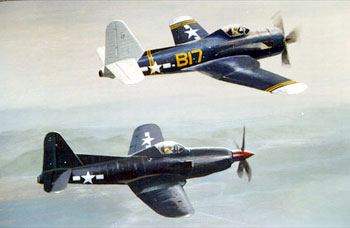
Foreward: This month DeWayne Barnett sent in a wish list that included the following 3 aircraft; The Northrop XP-56 'Black Bullet', the Ryan FR-1 'Fireball' and the Ryan XF2R-1 'Dark Shark'.
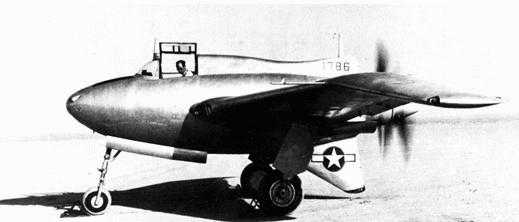
First model:The Northrop XP-56 'Black Bullet.' The Model N2B (XP-56) was design to the Army Air Corps R-40C proposal (as were the XP-54 and XP-55). She was an all-magnesium aircraft with a span of 42 ft 6 in, length of 27 ft 6 in and height of 11 ft. She was powered by a 2,000 hp Pratt & Whitney R-2800-29 motor, giving her a maximum speed of 465 mph at 19,300 ft(est). The first prototype made its first flight Sept 30, 1943, but was destroyed during a taxi test. The seconds first flight was March 23, 1944 and had a larger vertical stabilizer and an improved wingtip design incorporating a yaw control system. Like the other two aircraft of the R-40C proposal, the XP-56 flight tests revealed no significant performance improvements over conventional types already in service and never entered production.

Second Model: Ryan FR-1 'Fireball'.The US Navy relized in 1942, that the new jets required excessive take-off runs, high touch-down speeds, long roll-outs, had high fuel consumption and the lag in immediate and initial power or thjrust when full throttle was needed during a bolter. So the Navy initiated investigations into alternate solutions to counter these new jets. By late 1942 the Navy decided upon a composite-powered fighter. Ryan was chosen out of nine manufacturers that the proposal was given. The first XFR-1 made its first flight june 25, 1944 and the second XFR-1 on September 20, 1944. The FR-1 was a single place, low wing monoplane with many firsts for the US Navy. The first laminar flow airfoil for carrier use, the first tricycle landing gear used on a single-engined carrier aircraft and first Navy plane to have entirely flush riveted exterior with all control surfaces covered by metal. And last, the first operational composite carrier aircraft. The FR-1 diensions are: a span of 40' by 32' 1" long and a height of 13' 7 5/16". Powered by a Wright Cyclone R-1820-72W, 9 cylinder, 1350 HP radial engine in the nose and a General Electric I-16 (J-31), 1600 Lb thrust turbojet engine in the tail. They were delivered to the first squadron (VI-66) in March of 1945 to combat the Okha kamikazes.


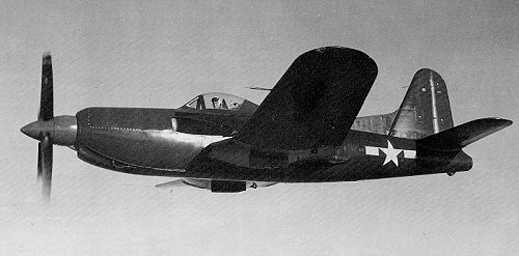
Third Model: Ryan XF2R-1 'Dark Shark'. NAVAIR issued requirement SD399, which called for a single-seat fighter powered by a turboprop engine in the nose and a jet in the tail. Ryan modified FR-1 39661 and redesignated it XF2R-1. The forward fuselage was extended to house the General Electric TG-100 'propjet' giving an overall length of 36'. The XF2R-1 made its first flight in November of 1946. Performance-wise the aircraft was about 75 mph faster than the FR-1 and 25 mph slower than the XFR-4, therefore she was never put into production.
In Conclusion: Designers should you like more info on these three aircraft (i.e. photos, drawings or other data), contact me at borgr2003@yahoo.com. Others, submit your wish list, the designers do not know what you would like to see unless you tell them.
