Photos by the author


I built the "Pou du Ciel" as a gift for my artist brother, Steve, who often includes a small aircraft in his paintings. I thought that the "Pou" would give him something with some added visual interest to draw. The model is of a between-the-wars lightplane designed by Frenchman Henri Mignet. Chauncy Green designed this model for Fiddler's Green. He did a wonderful job. The only drawback to the version I built was the tiny size of a few parts. The larger version would be easier to construct.
Here are a few of my observations, which may help you in constructing this charming model:
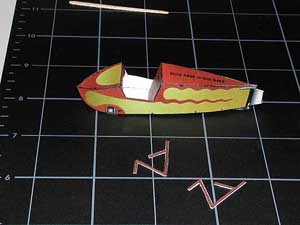
First construct the body shell. Then, working front-to-back and one pair of tabs at a time, glue in the nose deck. The bottom panel should be installed in similar manner, though there may be a need to trim at the tail end. I added a couple of extra card formers for strength before closing up the fuselage.
You can see from the various shots that I rolled the wings into a reflexed shape on top. This is a curve that changes from convex to concave toward the trailing edge of the wing. The actual airfoil is like this, but I can't be sure if Mr. Green meant us to build it that way. The wings went together very nicely, but I glued the front edges first, as seen in the illustration, and then planned to glue the remaining tabs from underneath. Dry-fitting the bottoms of the wings led me to leave a couple of the outer joint tabs for last. In one illustration I've slipped a sheet of paper in the joint to show that it's still open. I might have avoided doing it this way had I opted for a conventional curve to the airfoil.


The tiny engine can be a challenge, but placing a tiny scrap of card vertically between the front and back surfaces holds them in position so that the skin can easily be fastened. In the illustration it looks like thick wood, but it's really just card. The engine mount went together nicely, but I was apprehensive about its ability to support the top wing. To remedy this I attached a tiny piece of wire behind the mount and made two holes for it to fit into. That made mounting the engine and wing much easier. I suspect that the wire was unnecessary from the outset.


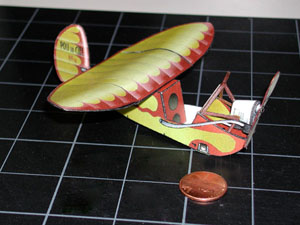
I was very pleased with this model and may build another of the several colorful versions that Fiddler's Green has available. I photographed the completed model sitting on a scale drawing of the actual aircraft. The drawing is from one of Bill Hannan's wonderful publications - "Models & Modelers International" (www.hrunway.com). While perhaps not a best first model, anyone who has built a couple of card models should do a fine job with this one.
