Photos by the author
History:
This German three/four seater bomber was in service from 1937 to
1945. When it was new this bomber was called the "Flying Pencil".
Originally designed as a six passenger high speed transport, the DO-17 was
turned into a bomber- the reverse of what usually happened in the 30's, when
new bombers were disguised as airliners. The prototype demonstrated at an
air show at Zurich startled the crowds by outpacing the best fighters.


The KIt:
This model has brief instructions in English and German and five
sheets of assembly diagrams that are quite precise. There are seven sheets
of parts, formers and connecting strips. There is also a brief history. It
is produced by CFM and designed by Dr. Emil Zarkov.
Construction:

The sequence of building found in the instructions were
followed. The option of a detailed cockpit and transparent canopy were
selected and the nose section and cockpit were built. After completing the
cockpit I realized that the transparency was only for the cockpit and there
was a lot of glass in the nose of the plane. Many tries were made to build
transparent material into all sections of the nose. This was an impossible
task due to the many parts which were almost all glass and the connecting
strips which had to be used to assemble the fuse. So-- I went back to
non-glass parts which hid the cockpit. After this setback the fuselage build was standard using formers and connectors rather than butt-joining.

It is an easy matter to transition from the fuselage to the wings. I
found that assembly of the wings was much easier if the reinforcing elements
of the central fuselage and the wings are built adding gussets in all right
angle joints. It only takes a few minutes and skinning the wings is much
easier when the structure is stronger.
The fuse, wings and tail sections were completed and work started on
the engines, nacelles, landing gear and props.

The engines were built as subassemblies. It is a shame that the
engines are almost hidden when placed in their housings. The landing gear
were very detailed.(21 parts each plus the wheels). At no time was it
necessary to try and figure out what part went where and how they fit. The
subassemblies were difficult due to their size, but not hard to build.
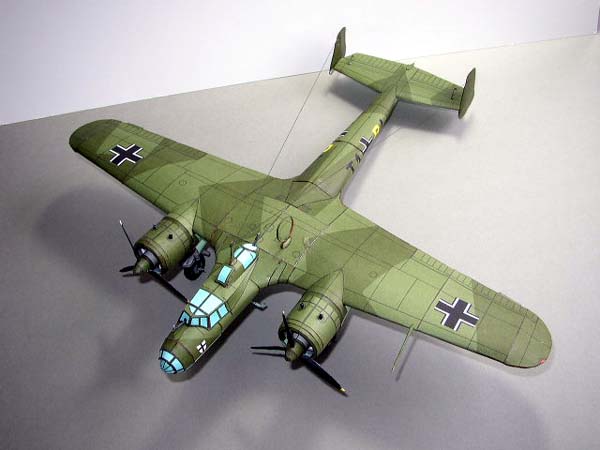
Final assembly was easy and very rewarding, the model came alive with details.
Conclusion:
This is the best model I have built to date. The fit of the
parts and the blending of complex lines such as wing roots and underbelly of
the plane take shape beautifully. Dr Zarkov has done an incredible job of
design and refinement. As you build the model you begin the realize you are
going to have a winner when you finish and you wont be disappointed.. Any
booboos you see in these pictures are my fault. A real paper masterpiece
that will be number one in my collection.



Summary:
| Model: | Dornier D0 17P |
| Publisher: | CFM |
| Scale: | 1/50 |
| Difficulty: | Imtermidate |
| Number of Parts: | 387 |
| Instructions: | Good |
| Diagrams: | Very Good |
| Fit: | Outstanding |
| Coloring and Artwork: | Excellent |
| Printing: | Excellent |
