The U.S.S. Oregon Is a 1:250 th scale card model designed by Roman Detnya and can be purchased at The Digital Navy web site (www.digitalnavy.com) . Digital Navy has several offerings for the medium to advanced skill builder. They also have several Free downloads to try before you buy. I would highly recommend that you build a couple of the free ones before you spend the money on one of their kits. I received the printed "Buff Scheme" of this model. When you purchase the model you have the option of buying the kit on CD or getting it printed for a slight cost increase. The purchased product ships in three different color schemes. The model as I received it came on 13 sheets of card stock and 1 sheet of heavy gloss paper. Instructions were printed and included several good construction diagrams for parts placement. The nice thing about Roman's models are you can build a great model with what ships with the kit, or you can add some extra "deck tackle" and see the model really come to life. To give a better view of my photos I have linked them to a full size version. just click on the photo to enlarge it.
Construction Details (Part 1 of 2)
I started construction by laminating sheets of manila folder to get the desired thickness for the hull parts. I prefer manila folder to card stock as it has less chance of warping when you laminate them. I used two sheets of manilla for each hull part sheet. this gave me the 1mm thickness recommended by the designer. I would say that this thickness is critical to getting a good fit later in the build process. It appears that the designer's dimensions are calculated around this and you would find some parts need to be corrected if you don't get this thickness right.
The Hull
 I started the hull by cutting out all of the formers and dry fitted them to insure the fit was good. Hull construction is of the "Egg Crate" design with the upper and lower hull sections being joined to a "middle deck" This model can be constructed as a full hull or a water line hull display. I chose the full hull for this build.
Next I joined the lower hull to the middle deck. I used just enough glue to wet the cross members and press fit the structure to the deck. I refrained from using a glue fillet on the hull cross members because in prior model builds I experienced some warping of the deck when I filleted the joined sections.
 After allowing the lower hull to dry, I installed the upper hull former to the middle deck. I repeated the glue process and press fit the upper hull former to the middle deck, insuring that the cross members lined up with the cross members on the lower hull. Hind sight being 20/20 I will copy the middle deck pattern and glue it to the bottom of the middle deck so that I have a guide to aid in lining up the cross members next time.
 Next in the construction process I added the "ribs" to the cross members to give some additional glue surface for the hull skin joints. I really like this feature of the model as joining the skin sections without the "ribs" makes joining much more difficult.
Skinning the Hull
 Now the fun begins. I started skinning the hull from the stern and moved forward since the most complex curves and folds are at the stern. First I cut out the hull skin sections and pre-folded them to get the general fit right. Next, I applied glue to the inside surface of the section and press fit them to the hull formers. I normally apply the glue to the skin as opposed to the former to help keep the skin parts clean of excess glue. If I do get glue on the external parts I try wipe it off with a damp (not wet) sponge.
 After I finished applying the lower skin I left the hull to dry. Notice on the rear sections there is a slight gap in the joins. The colored ribs are really helping to hide the gap in the joined sections. You could even apply coloring to the cut card edges and make gaps really disappear. All-in-all I think the fit of the hull sections on this model are excellent.
 With the lower hull dry, I proceeded to attach the upper hull sides. I personally think this is the hardest part of the hull construction process as I always seem to get the alignment wrong. To help minimize this I attached the anchor chutes to the hull sides before I joined the side to the form. This helped to line up the front sections and I only had a minimal gap at the front and rear to deal with.
 With the hull completely skinned I let the assembly dry while I sat back and enjoyed the progress so far. I did use some white acrylic paint to cover the joins in the upper hull.
 At this point I was a little disappointed with the printed color of the hull (and a couple glue splotches I forgot to clean), so I painted it adobe red. I think the color more closely matches red lead paint. It also helped fill in the skin joints quite nicely. I then jumped forward in the build process to the decks. I wanted to wait on mounting the propellers, shafts, and rudder as I always seem to knock them off then I'm handling a model during construction
The Decks
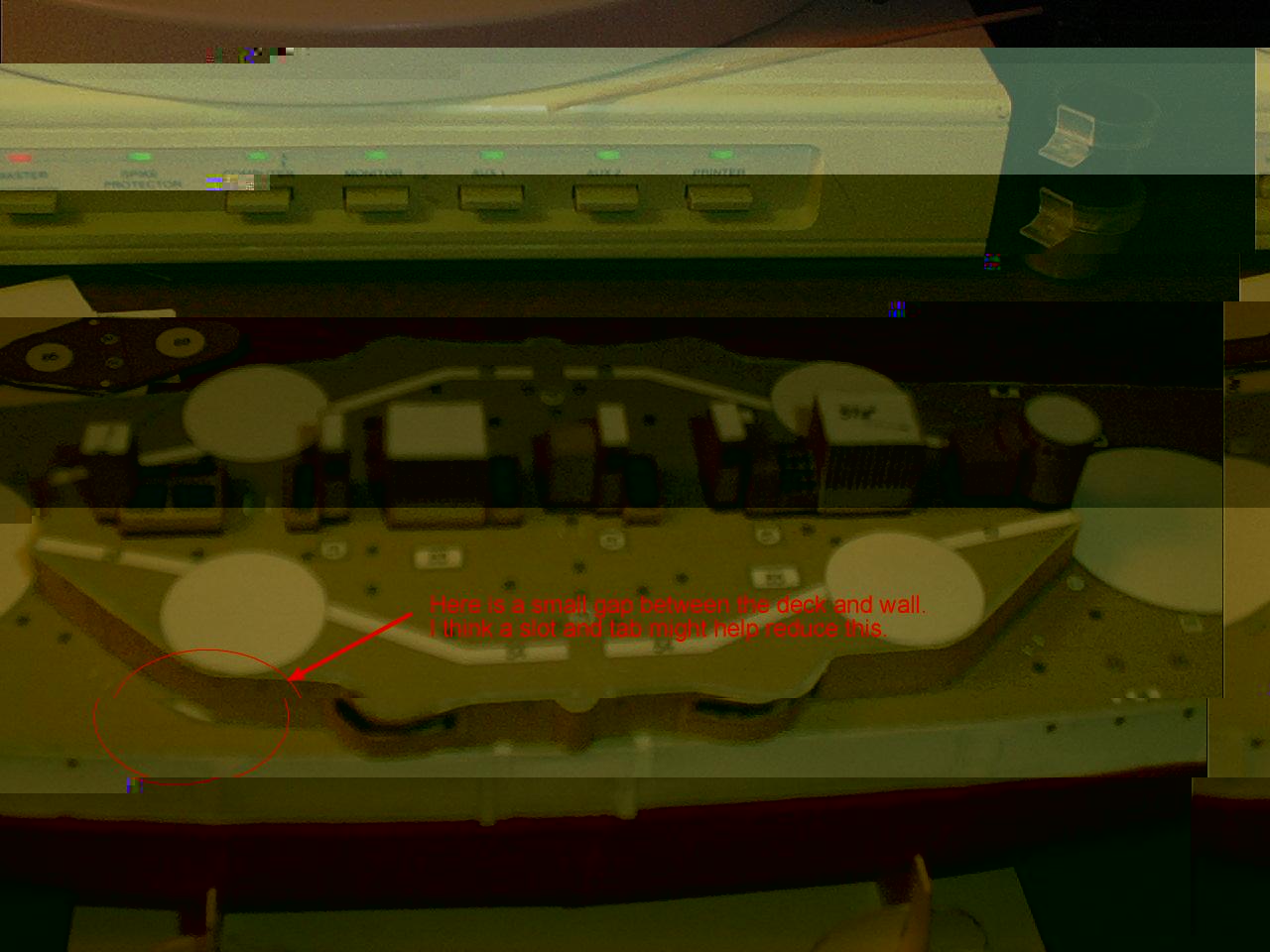 Deck construction starts with the gun deck. I cut out and fit the gun deck to a cardboard stiffener. Next, I mounted the deck walls to the bottom of the gun deck and the card mounts for the walls to the main deck. I then installed the two interior walls and the four 6in. gun chassis to the main deck. I didn't mount the barrels to the 6in. guns as the gun deck will slide down over the card formers glued to the main deck. One thing that would make the wall alignment better would be the addition of slots in hatted main deck to allow tabs on the gun deck walls to pass through. Notice on the picture the small white patch next to the gun deck wall.
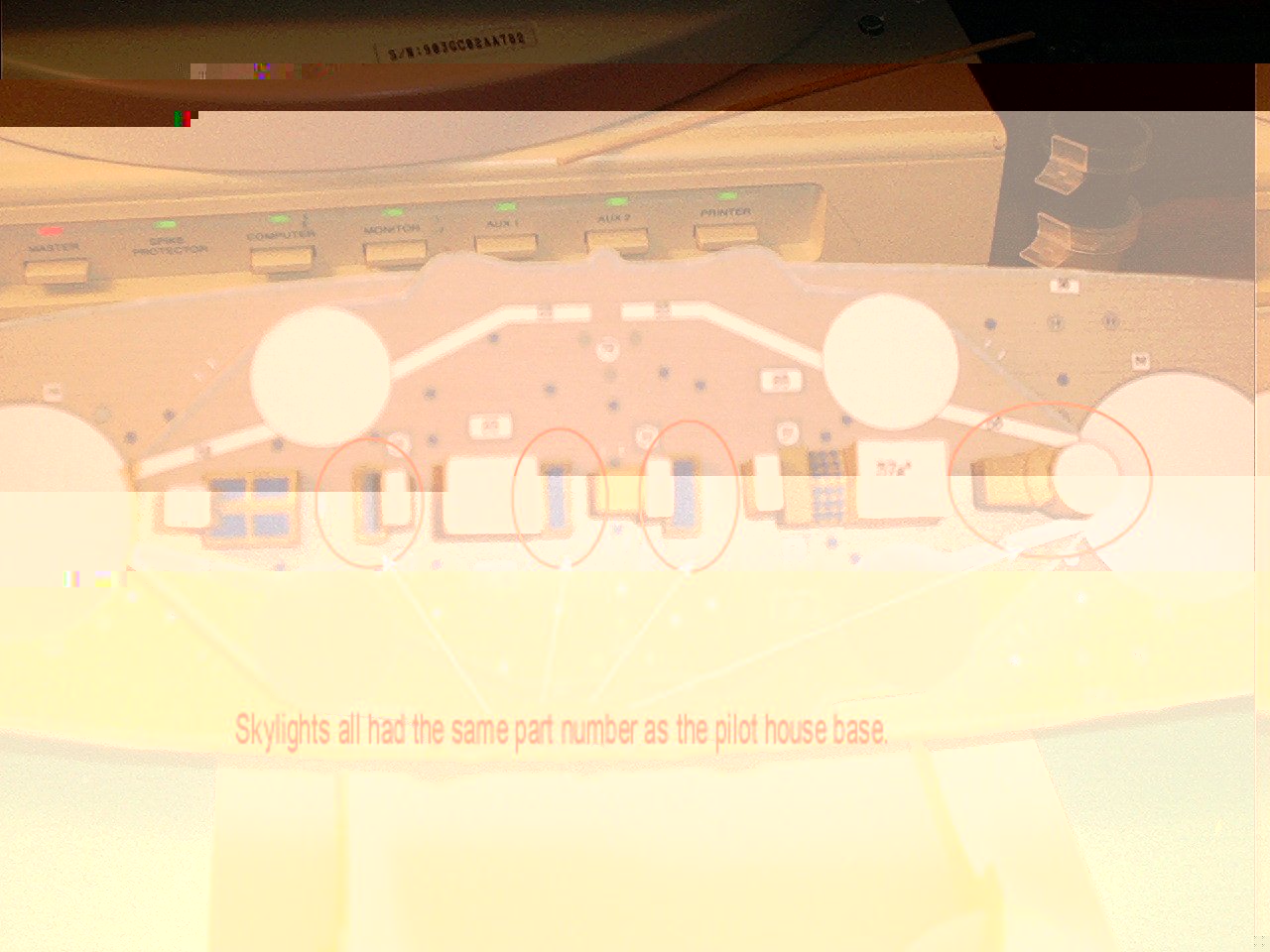 As I started mounting the cabin structures on the gun deck I found there was an error in numbering some of the pieces. The sky lights were numbered 38 as was the pilot house base. the skylights probably should have been numbered 45 as the pieces were numbered 45 a & b. It is easy enough to figure out, but I thought I would point it out to avoid confusion.
 After Mounting all of the deck structures and hatches I built the walls and the 8in. barbettes.Here is a picture of the walls in place and two of the barbettes mounted. I took the oppertunity at this point to mix up some "Buff" paint to color the cut edges. I scanned a section of a buff part and got the average rgb values of the buff color. Then I mixed the paints and made a test patch of the mixed color to scan. I compared the RGB values to see how far of my color was to the printed color and corrected it. It is a bit of extra work but I like for the seams in a model to disappear.
 With the exterior walls in place, I added the life boat mounts and rolled the "wings" from the exterior walls down and secured them. In this view I've also added the flying bridge, stacks, pilot house, and a small tower on the aft flying bridge with the targeting instruments mounted in place. The small tower has Part 111 on it and I encountered a problem here. Part 111 was actually 111 and 111a. the diagram shows part 111 as the only item mounted. I looked over some pictures of the Oregon I found on hte web and it appears that 111 and 111a would both be mounted there. I think this item is the torpedo angle on the bow calculator. If anyone out there knows for sure let me know please.
 Things were progressing well with this model and I was feeling quite good with myself at this point. My 2yr old son Tristan stepped in and made a few modifications of his own at this point. Aggh!! in a few minutes he totally crunched the upper decks and tore a few pieces in his quest to turn my model into a diarama of the Oregon at the scrap yard. Several pieces had the printed detail so torn up I wasn't sure it could be repositioned. Well I promised a review so I'll try to reconstruct the damaged areas. Needless to say I was feeling a little queasy at this point.
 After some serious reconstruction I was able to get the flying bridge and the bits and pieces back together. I mixed up some acrylics to match the deck color and walls that were damaged. After a little touch-up painting here are the results. There are a couple noticeable spots and the fine deck lines on the flying bridge deck are gone but all in all it looks pretty good. wall section on the bottom of the picture still has a noticeable tear in the card but I'm working on a way to conceal that.
 Having corrected most of the damage to the upper decks I moved on to the fore deck and mast. Here you can see the 13in. barbette and mast in place. I'm concluding this part of the construction review here. Next month I'll finish the review and provide some tips for sprucing up the model with some add-ons like rails and other deck items I like to add for realism.
| Classification: | Sea-Going Coast-Line Battleship, BB-3 | |
|---|---|---|
| Keel Laid: | November 19, 1891 | |
| Completed: | November 19, 1893 | |
| Comissioned: | July 15, 1896 | |
| Rig: | One military mast. | |
| Armament: | Four 13" barbette guns | |
| Eight 8" barbette guns | ||
| Four 6" guns | ||
| Twenty 6 pounders | ||
| Six 1 pounders | ||
| Two Colt Gatling Guns (for landing parties) | ||
| One 3" field piece (for landing parties) | ||
| Three Whitehead torpedo tubes | ||
| Contractor: | Union Iron Works, San Francisco, CA | |
| Length: | 348 feet | |
| Beam: | 69 feet 3 inches | |
| Mean draft: | 24 feet | |
| Max. draft fully loaded: | 27 feet, 1-3/4 inches | |
| Displacement: | 10,288 tons | |
| Complement: | 32 officers and 441 enlisted men Commanded by Capt. C. E. Clark until August 6, 1898 when Capt. A. S. Barker assumed command. | |
| Engine type: | Vertical triple expansion engines with a 42 inch stroke, | |
| generating 11,111 hp. Twin screw. | ||
| Boiler type: | Four double-ended and two single ended cylindrical boilers. | |
| Speed: | 16.79 knots | |
| Coal bunker capacity: | 1,594 tons | |
| Endurance @ 10 knots: | 5,500 nautical miles | |
| Armor: | 18 inches on sides, 6 -17 inches on turrets | |
| Cost: | $3,180,000 |
|
Model: |
U.S.S. Oregon BB-3 |
|
Kit: |
Digital Navy |
|
Designer: |
|
|
Availability: |
From Digital Navy, http://www.digitalnavy.com/
|
|
Scale: |
1/250 |
|
Difficulty: |
scale 1-10 this model is a 6 |
|
Number of Parts: |
550ish?? (I forgot to count them) |
|
Instructions: |
Excellent, in English |
|
Diagrams: |
Several excellent detailed diagrams. |
|
Fit: |
Scale 1-10 this model is a 10 |
|
Coloring and Artwork: |
scale 1-10 this model is an 8. The Printed version I received was good. I did feel the need to change the hull color. |
|
Printing: |
Scale 1-10 this model is an 8. � (I only received 1 of the 3 model schemes and there were a few minor printing errors,but nothing that detracts from the final build of the model.) |
