GPM024 Graf Spee
by Herb Schmidt
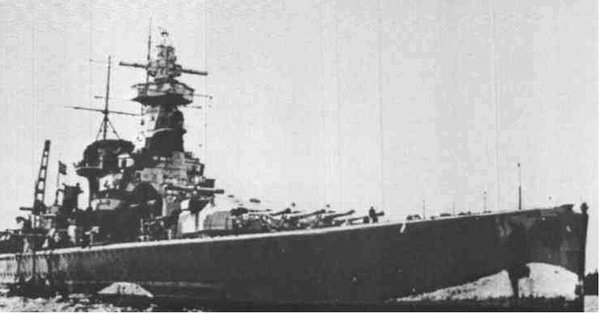
A few months back I was watching a movie on TV titled "The Battle of the River Plate", a film produced in Great Britain during the 1970s. This movie had the original title "Pursuit of the Graf Spee" and got my interest to the level that I had to know more about this ship and the events depicted. Searching the internet resulted in my purchasing a wonderful book written by Joseph Gilbey titled "Langsdorff of the Graf Spee � Prince of Honor". It tells the story of the last three months of the Panzerschiff Admiral Graf Spee, the "pocket battleship" of the Kriegsmaring, and of its remarkable captain, Hans Langsdorff. After reading this book, I was amazed how accurately the movie told this story.
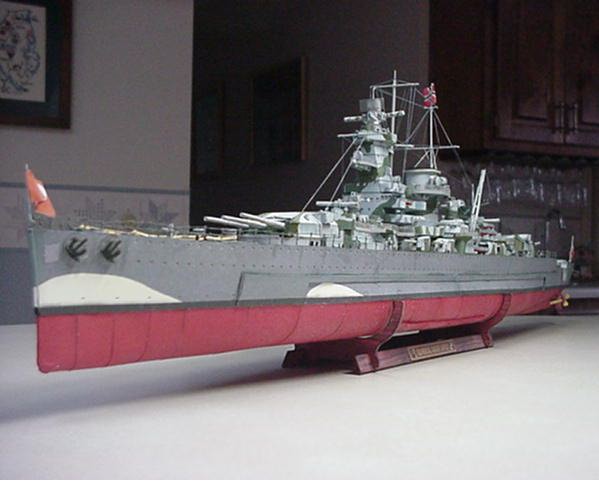
Of course, now I had to build a model of the Graf Spee to learn more about the details of this vessel. What better way than to make a card model of the subject. I ordered the GPM 024 kit and began construction. It was completed two and one half months later, working an average of four hours a day.
History of the Panzerschiff Admiral Graf Spee
Launched 30 June 1934 at Wilhelmshaven, it was the third ship in the Deutschland class. All three ships were designed as commerce raiders and built loosely under the weight restrictions of the Versailles Treaty. They were actually cruisers but had the appearance of larger "true" battleship, hence they were called "pocket battleships".
Dimensions:
610 m length
67.9 m beam
23.8 ft. draught
16,230 tons displacement
Innovations:
secret gun sight system
welded hull
electronic controls
radar
diesel engine power
Operations:
Sea trials started May 1936. She took part in training missions and state visits until September 1939 when she was assigned wartime operations in the South Atlantic and Indian Oceans. The Graf Spee patrolled the seas searching out cargo ships aiding Allied causes. (It was felt the raider did not have enough armor plate to engage similar warships). During its three months of war operations it sunk 9 merchant ships. The most astonishing fact is that Captain Langsdorff would not allow any of the merchant sailors to be harmed. He always offloaded the crews before sinking the ships. Usually the interned crews were quartered on the Graf Spee, treated humanely, and fed as one of the ship�s company. They were offloaded to neutral countries unharmed when the opportunity presented itself.

On 13 December 1939, the Graf Spee was spotted by the British Heavy Cruiser HMS Exeter, accompanied by the light cruisers HMS Ajax and HMS Achilles. A fierce battle ensued, the Exeter being put out of battle by the accurate fire of the Graf Spee. But the Spee was also damaged. Langsdorff, realizing he was outnumbered, made a run for the neutral port of Montevideo where, under International Law, the ship could be repaired only to make it sea worthy, not increase its fighting ability. The ship remained in the harbor for 72 hours, with the British ships waiting for the Spee to go to sea. Langsdorff offloaded most of his crew to a German merchant ship bound for Argentina. The remaining crew fired up the diesel engines on the Graf Spee and started out of the harbor. All of a sudden, numerous explosions were seen and heard by the huge crowd that had gathered on the shore. Langsdorff had set charges to scuttle the ship in the harbor channel. He and his small crew departed the sinking vessel. It was 17 December 1939. The captain and his remaining crew managed to flee to Argentina.
The Model:


This model is typical of the quality produced by GPM. It is rated as a Difficulty 2, but my personal impression is that it should be rated higher. I previously made the GPM U.S.S. Enterprise (CVAN-65), which had 1000+ more parts than the Graf Spee kit, but I believe was much easier to build. The amount of extremely small and complex parts makes construction tedious, the Arado 196 float plane alone incorporating 45 pieces. (Have a couple of good tweezers handy.) But this is typical of a model of this size.

Construction is similar to most card model ships, �egg crate� hull internal structure, and built up superstructure and peripheral parts. I found nothing of note to detract from the instructions, and the diagrams are superb. One just has to be patient and realize this model will take considerable time to complete, but it is worth it. It makes up into a very accurate and eye catching project.

Comments:
The way I approached the selection of this kit is how I often tend to make models. I feel modeling is a great source of learning, and I try to research not only the detail, but also the history of the subject. Making the Panzerschiff Admiral Graf Spee has enabled me to learn about the ship, its adventures, and its captain, and have enjoyment in the process.




Model Specs:
GPM 024
22 sheets
1930 parts
Format 210 mm x 300 mm booklet
Completed length: 930 mm
Height to top of mast: 220 mm
Beam: 110 mm
Difficulty 2
Scale 1/200
