Kartonowa Flota USS John D.
Ford
Robert Forbes

History:
John D. Ford ( DD-228) was laid down by William Cramp & Sons Ship & Engine Building Co., Philadelphia, Pa., 11 November 1919; launched 2 September 1920, sponsored by Miss f. Faith Ford, daughter of Rear Admiral Ford; and commissioned as Ford 30 December 1920, Lt. ( j.g. ) L. T. Forbes in temporary command.
After acceptance trials off New England, Ford received Lt. Comdr. C. A. Pownall as commanding officer 16 July 1921. On 17 November, while operating along the eastern seaboard, her name was changed to John D. Ford. After training in the Caribbean, she departed Newport, R.I., 20 June 1922 for permanent duty with the Asiatic Fleet. Sailing via the Mediterranean Sea, the Suez Canal, and the Indian Ocean, she arrived Cavite, Manila Bay, 21 August to begin almost two decades of service in the Far East.
Prior to the outbreak of World War II, John D. Ford operated out of Manila, cruising Asiatic waters from southern China to northern Japan. During April and May 1924, she helped establish temporary air bases on the Japanese Kurile and Hokaido Islands in support of the pioneer, global flight between 9 April and 28 September by the U.S. Air Service. On 6 June she deployed to Shanghai, China, to protect American lives and interests which were threatened by Chinese civil strife. After renewal of the Chinese Civil War in May 1926, she patrolled the Chinese coast to protect convoys from roving bands of bandits. On 24 March 1927 she supported the evacuation of American and foreign nationals, who were fleeing from mob violence at Nanking.
The ascendancy of the reformed Nationalist government under Chiang Kai-Shek in 1928 quieted civil strife. However, Sino-Japanese relations deteriorated, requiring John D. Ford to remain in China. Following Japanese aggression in northern China during July 1937, she evacuated Americans from Peiping us Japanese ships prepared to blockade the Chinese coast. Steaming to Manila 21 November, she operated between the Philippines and southern China on fleet maneuvers. And after war broke out in Europe in September 1939, she increased training off the Philippines and commenced neutrality patrols in the Philippine and South China Seas.
After the Japanese attack on Pearl Harbor 7 December 1941, John D. Ford readied for action at Cavite as a unit of DesDiv 59. Undamaged by the destructive Japanese air raid on Manila Bay 10 December, she sailed southward the same day to patrol the Sulu Sea and Makassar Strait with Task force 6. She remained in Makassar Strait until 23 December, then she steamed from Balikpapan, Borneo, to Surabaya, Java, arriving the 24th.
As the Japanese pressed southward through the Philippines and into Indonesia, the Allies could hardly hope to contain the enemy's offensive in the East Indies. With too few ships and practically no air support they strove to harass the enemy, to delay his advance, and to prevent the invasion of Australia. Anxious to strike back at the Japanese, John D. Ford departed Surabaya 11 January 1942 for Kupang, Timor, where she arrived the 18th to join a destroyer striking force. Two days later the force sailed for Balikpapan to conduct a surprise torpedo attack on Japanese shipping. Arriving off Balikpapan during mid watch 24 January, the four destroyers launched a sweeping raid through the Japanese transports while Japanese destroyers steamed about Makassar Strait in search of reported American submarines. For over an hour the four-stackers fired torpedoes and shells at the astonished enemy. Before retiring from the first surface action in the Pacific war, they sank four enemy ships, one a victim of John D. Ford's torpedoes. The victorious striking force arrived Surabaya 25 January.
The Japanese pincer offensive through the Dutch East Indies continued despite Allied harassment. On 3 February the enemy began air raids on Surabaya, and John D. Ford retired in convoy to Tjilatjap on the southern coast of Java. During mid-February the Japanese tightened their control of islands east and west of Java, and on 18 February they landed troops on Bali, adjacent to the eastern end of the Java. In response John D. Ford, Pope (DD-225), and other American and Dutch ships steamed to Badoeng Strait in two waves to engage an enemy destroyer-transport force during the night of 19-20 February. A unit of the first wave, John D. Ford conducted a running engagement with two Japanese destroyers without results; while the Japanese retired northwards after the second wave, their landings on Bali were successful. Moreover, they sank the Dutch destroyer Piet Hein while suffering extensive damage to only one ship.
Returning to TjilatJap 21 February for fuel, John D. Ford and Pope immediately sailed to Christmas Island to pick up the last reserve of 17 to 18 torpedoes from Black Hawk (AD-9). Then they steamed to Surabaya, arriving the 24th to join the dwindling ABDC Striking Force. Hampered by shortages of fuel, ammunition, and torpedoes and reduced in strength by sinkings, battle damage, and repair needs, the Allies indeed faced a "critical situation." Only four U.S. destroyers remained operational in the Striking Force.
Late on the 25th, John D. Ford sortied with the Striking Force from Surabaya in search of a large enemy amphibious force in the Java Sea. Returning to port the following day, the force was joined by five British ships; once more the Striking Force steamed to intercept the enemy. Following an unsuccessful strike by enemy planes the morning of the 27th, the Allied force steamed for Surabaya. While steaming through the mine field, the ships reversed course and deployed to meet the enemy off the northern coast of Java.
The Battle of Java Sea commenced at 1616 and continued for over 7 hours. The Allied ships, 5 cruisers and (9 destroyers;, engaged the enemy force, 4 cruisers and 13 destroyers, in a furious running battle marked by intermittent gun and torpedo duels. John Ford emerged from the battle undamaged but in the valiant attempt to prevent the invasion of Java, five Allied ships were sunk.
Retiring to Surabaya. John D. Ford and three other destroyers of DesDiv .,58 departed after dusk 18 February for Australia. Steaming undetected through the narrows of Bali Strait during midwatch 1 March, the gallant old four-pipers encountered three enemy destroyers guarding the southern end of the strait. Out of torpedoes and low on ammunition, the destroyers outdistanced the Japanese patrol and steamed for Freemantle. Lt. Comdr. J. E. Cooper, who had skippered John D. Ford since before the outbreak of the war, brought her safely to Australia 4 March.
After 2 months of convoy escort duty along the Australian coast, John D. Ford departed Brisbane on 9 May for Pearl Harbor. Arriving 2 June, she sailed in convoy 3 days later for San Francisco and arrived 12 June. She cleared San Francisco for Pearl Harbor 23 June, and during the next 11 months escorted nine convoys between San Francisco and Pearl. Returning to the West Coast 20 May 1943, she departed San Francisco 24 May for convoy and ASW patrols in the Atlantic.
Assigned to the 10th Fleet, John D. Ford transited the C,anal 4 June and joined a Trinidad-bound convoy the 8 th. For the next 6 months she ranged the North and South Atlantic from New York and Charleston, S.C., to Casablanca, French Morocco, and Recife, Brazil, protecting supply convoys from German U-boats. After ASW training late in December, she joined Guadalcanal ( CVE-60) out of Norfolk 5 January 1944 for hunter-killer activities operations in the Atlantic. The versatile destroyer supported the destruction of German submarine U-554, surprised and depth charged while refueling west of the Azores 16 January.
After returning to the East Coast 16 February, John D. Ford cleared Norfolk 14 March for a convoy run to the Mediterranean. While at Gibraltar 29 March, she was damaged in a collision with a British tanker. Following repairs, she returned to Norfolk, arriving 1 May. Departing Norfolk 24 May for convoy duty to the Canal Zone, John D. Ford continued convoy patrols for almost a year from eastern seaboard ports to Recife, ReykJavik, and Casablanca.
From 24 May 1945 to 27 June she acted as escort and plane guard for Boxer ( CV-21) during the carrier's shakedown in the Caribbean, then she returned to Norfolk. She sailed 8 July for Boston Navy Yard where she arrived 9 July for conversion to miscellaneous auxiliary AG-ll9. After conversion, she returned to Norfolk 9 September and decommissioned 2 November. Subsequently, she was sold for scrap 5 October 1947 to Northern Metal Co., Philadelphia, Pa.
John D. Ford received four battle stars for World War II service.
(Courtesy of www.hazegray.org)
The Model:
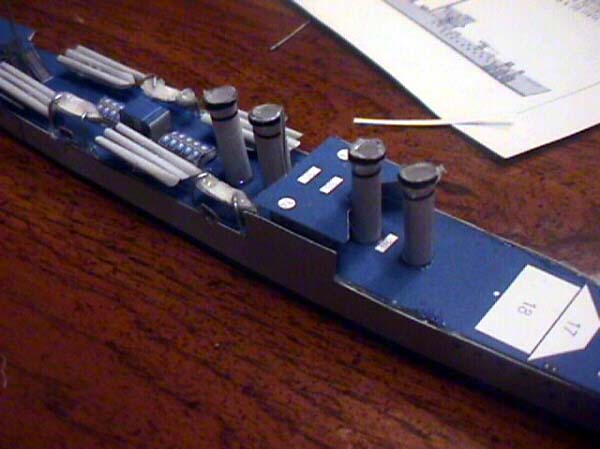
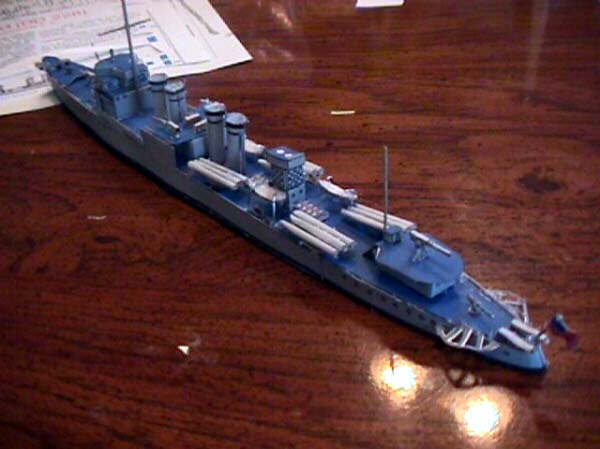
Overall, I found the model to be a fun, relatively fast build, and it built up into a reasonably detailed, nice-looking water-line model. The fit was very good for the most part, and it does not suffer from the repetitiveness that plagues so many ship models. However, there are was one issue that I found annoying.
The instructions consist of a top view diagram, a side view diagram, and a couple of paragraphs in Polish. There are no close-up diagrams of complicated areas like the superstructure or the guns. There is no diagram at all for the rigging. If you build this model, be prepared for a lot of guesswork or a lot of research. Also, when I finished the model, I had several parts left over which were not mentioned at all in the instructions. The model looked good without them, but I still have no idea where they were supposed to go.
Even with the lack of instructions, though, the model is not very difficult to build. The parts are laid out on the page well, giving you more building time and less where-the-#$!@-is-part-57 time. Although there were some areas (such as the superstructure) I found confusing, most of the problems could be figured out with a little common sense. Even with its minor problems, the John D. Ford looks good enough on the shelf next to my Digital Navy models, and was much easier to build.
The Kit:

The kit is a 1:300 scale model of the USS John D Ford that comes in a PDF file with 2 pages of parts and 1 page of intructions. I printed mine on 20 lb. cardstock with a Canon Multipass F30 printer. The coloring of the parts is impressive and appears to be accurate. The instructions, however, are inadequete for the model. The sheet has 3 drawings of the entire ship. Two are diagrams marked with part numbers, one side view and one top view. The third is a colored side view without part numbers. The sheet also has a few paragraphs in Polish. The diagrams that are included are good, but they are just not enough.
Construction:
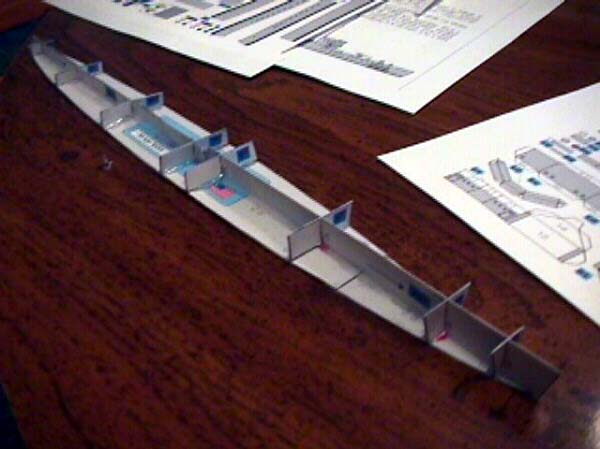 The
hull uses the standard egg-crate style formers. I laminated the formers,
the deck, and the hull sides to double thickness, but if I build it again,
I probably wouldn't double the hull sides. The formers went together
and the deck went on with no trouble. The first problem came with
the hull sides. When I attached them I found that they are about
1/8" too short. There is a gap at the tip of the bow. I later
filled it in with acrylic paint. The gap is still there, but it is
much less noticable. Part of the problem can be avoided by not attaching
the sides together at the stern before gluing them to the hull, as I did.
If I had not, the gap would have been divided between the bow and stern
and would have been much smaller.
The
hull uses the standard egg-crate style formers. I laminated the formers,
the deck, and the hull sides to double thickness, but if I build it again,
I probably wouldn't double the hull sides. The formers went together
and the deck went on with no trouble. The first problem came with
the hull sides. When I attached them I found that they are about
1/8" too short. There is a gap at the tip of the bow. I later
filled it in with acrylic paint. The gap is still there, but it is
much less noticable. Part of the problem can be avoided by not attaching
the sides together at the stern before gluing them to the hull, as I did.
If I had not, the gap would have been divided between the bow and stern
and would have been much smaller.
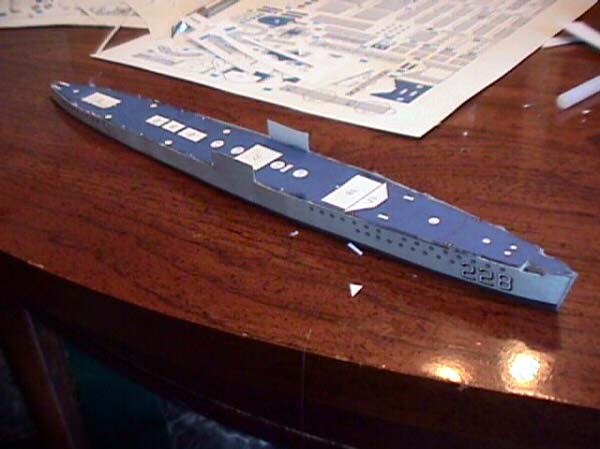 After
the hull was built, I started at the front and worked my way toward the
stern. The bow details and the forward superstructure were first.
The gun was somewhat challenging due to the detail and the small size,
but it was not any worse than any other ship model I've done. The next
part was the forward mast. I usually use dowels or wire, but on this
model I tried a sort of experiment. I was out of small dowel rods,
and I wanted something that would take paint well. I cut a straight
straw from a broom and dipped in gray acrylic paint. Then I cut it
to the proper length and glued it in place. Next I did the torpedo
tubes and lifeboats. The torpedo tubes and boats were fairly easy
and straightforward. However while the kit included paper lifeboat
hangers I replaced them with wire.
After
the hull was built, I started at the front and worked my way toward the
stern. The bow details and the forward superstructure were first.
The gun was somewhat challenging due to the detail and the small size,
but it was not any worse than any other ship model I've done. The next
part was the forward mast. I usually use dowels or wire, but on this
model I tried a sort of experiment. I was out of small dowel rods,
and I wanted something that would take paint well. I cut a straight
straw from a broom and dipped in gray acrylic paint. Then I cut it
to the proper length and glued it in place. Next I did the torpedo
tubes and lifeboats. The torpedo tubes and boats were fairly easy
and straightforward. However while the kit included paper lifeboat
hangers I replaced them with wire.
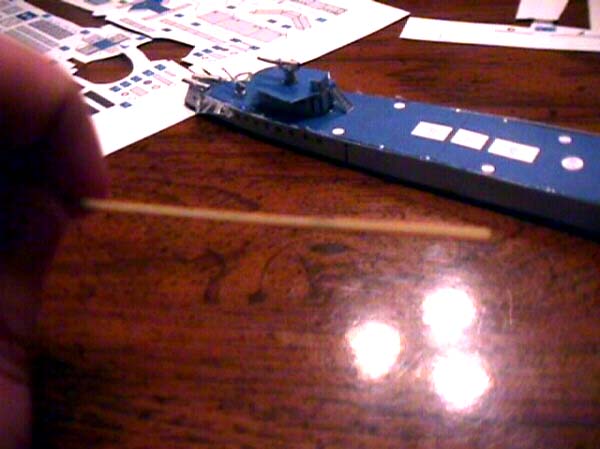 Next
I built the middle portion of the ship. Most of it was simple, but
there were several parts on the stacks that were not mentioned at all in
the instructions. I decided the the stacks looked good without them,
so I omitted them. Next I added the raised deck and built the guns
and a few other small pieces that attach to it. After that I installed
the bridge and mast. I built the mast in the same way as the rear
one.
Next
I built the middle portion of the ship. Most of it was simple, but
there were several parts on the stacks that were not mentioned at all in
the instructions. I decided the the stacks looked good without them,
so I omitted them. Next I added the raised deck and built the guns
and a few other small pieces that attach to it. After that I installed
the bridge and mast. I built the mast in the same way as the rear
one.
I had little trouble with the mast and bridge. The only real
problem was the angled piece on the front of the bridge which warped slightly
on me.
 After
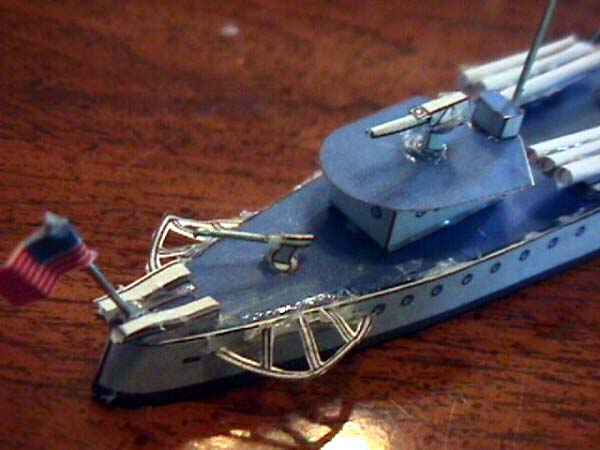
that, I moved on to the gun and the small details in the bow. After
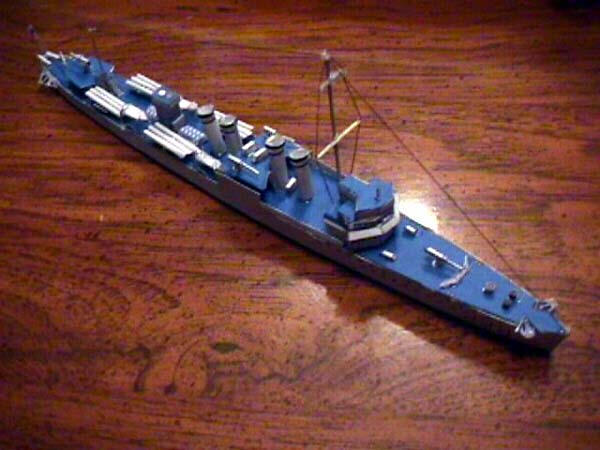
adding the anchors and other details, I rigged the model. The instructions
show no rigging at all so I added only minimal rigging detail. The
end result is actually very impressive for such a simple model.
After
that, I moved on to the gun and the small details in the bow. After
adding the anchors and other details, I rigged the model. The instructions
show no rigging at all so I added only minimal rigging detail. The
end result is actually very impressive for such a simple model.

Conclusion:
This model is overall very good. The parts fit is excellent
(except where I messed up!) and the finished product looks impressive.
The model is similar in quality to the Digital Navy products and does not
look out of place on my shelf with my other ships (paper and plastic).
I would definitely recommend this model, but I would suggest that any modeler
who has not built a paper ship before build one with better instructions
first.



Summary:
| Model: | USS John D. Ford DD-228 |
| Kit: | Kartonowa Flota |
| Designers: | Stanislaw Burnat |
| Availability: | http://www.kel.frame.pl |
| Scale: | 1:300 |
| Difficulty: | Medium |
| Number of Parts: | Approx. 100 |
| Instructions: | In Polish |
| Diagrams: | One side view and one top view |
| Fit: | Excellent, except for 1 or 2 parts |
| Coloring and Artwork: | Good |
| Printing: | Canon Multipass F30 good |
| Resources: | Destroyers
Online,
NavyHistory.com |
